
Parents: The Power is in Your Hands… Your Response to Their Complaints Shapes Who Your Child/Teen Becomes

As a family therapist with 25 years of experience in children's mental health, I've witnessed countless moments when well-meaning parents inadvertently shut down the very conversations they desperately want to have with their children, the conversations that build trust and bring you closer. Picture this: your teenager comes home upset about something that happened at school, or your child expresses frustration about a friendship conflict. Your natural parental instinct kicks in—you want to fix it, solve it, or help them see it differently. But what happens next often determines whether your child will continue coming to you or learn to keep their struggles to themselves.

Understanding the Window of Tolerance in Family Life
Before we dive into specific communication strategies, it's essential to understand how our nervous systems respond to stress and emotion. The concept of the "window of tolerance" describes that optimal zone where we can think clearly, respond thoughtfully, and maintain emotional regulation even when faced with challenges. When we're operating within our window of tolerance, we can access our problem-solving abilities, maintain connection with others, and navigate difficult situations with resilience. This applies to both parents and children. Before responding, there is a lot to consider. If you are talking to a child who is out of their window of tolerance, you are wasting your breath and may be furthering their withdrawal into disregulation.
Life inevitably pushes us outside this comfortable zone, triggering one of two protective responses: hyperarousal or hypoarousal. These responses aren't character flaws or behavioral problems—they're our nervous system's intelligent attempts to protect us from perceived threats.

When Children Experience Hyperarousal
Hyperarousal occurs when the nervous system kicks into high gear, activating the fight-or-flight response. In children and teens, this might manifest as:
Explosive anger or emotional outbursts
Arguing defensively or becoming combative
Difficulty sitting still or concentrating during conversations
Physical agitation or restlessness
Feeling like everything is an emergency or crisis
Risk-taking behaviors or impulsive decisions
When your child is in hyperarousal, their brain's alarm system is activated, making it nearly impossible for them to access rational thinking or problem-solving capabilities. This is when they need co-regulation from you—your calm, regulated presence to help their nervous system return to safety.

When Children Experience Hypoarousal
On the opposite end, hypoarousal represents the nervous system's shutdown response. This freeze or collapse state can be just as challenging for families, though it's often misinterpreted as defiance, laziness, or indifference. In children and teens, hypoarousal might look like:
Social withdrawal or emotional numbness
Lack of motivation for activities they usually enjoy
Difficulty expressing thoughts or feelings
Appearing "checked out" during conversation (eyes “glazed over”)
Sleeping too much or difficulty getting out of bed
Seeming compliant but emotionally absent
Understanding that both hyperarousal and hypoarousal are PROTECTIVE responses helps us respond with compassion rather than frustration. Your child isn't trying to be difficult—their nervous system is doing exactly what it was designed to do when it perceives threat or overwhelm (Note any parental tendency toward justification or defensiveness here).
The Critical Importance of Your Response
Here's what many parents don't realize: your response to your child's emotional expressions literally shapes their developing nervous system and their future capacity for emotional regulation. When children share their feelings, complaints, or concerns, they're essentially asking, "Is this emotion tolerable? Can I trust you with my inner world?
Your response sends powerful messages about emotional safety, trust, and their own worth. This is where the concept of distress tolerance becomes crucial—not just for your child, but for you as the parent.
Distress Tolerance: The Foundation of Emotional Resilience
Distress tolerance is the ability to survive crisis situations without making them worse through impulsive actions. It's the capacity to tolerate emotional discomfort without immediately trying to escape, avoid, or fix it. For parents, developing distress tolerance means learning to sit with your child's difficult emotions without rushing to make them feel better. This skill develops through gradual exposure to distress in a supportive environment.
In order to create this supportive environment, you must learn to sit with your own difficult emotional response to their emotions. There is a ripple effect here that is possible to learn to simply witness. Without action. When you can tolerate your own discomfort while your child processes their emotions, you're modeling this crucial life skill. More importantly, you're helping them build their own capacity to tolerate difficult feelings without resorting to avoidance behaviors.
The implications of this extend far beyond childhood. Poor distress tolerance contributes to various forms of addiction—to substances like drugs and alcohol, but also to behaviors like excessive gaming, pornography, compulsive spending, overeating, or even workaholism. When we haven't learned to tolerate emotional discomfort, we seek ways to escape or numb those feelings.
Your child is constantly looking to your lead to determine whether their emotions are tolerable. If you can remain calm and present with their distress, you're communicating that feelings are manageable and temporary. If you rush to fix, minimize, or change their emotional experience, you inadvertently communicate fear or worry, thereby sending the message that their feelings are too much—for you and potentially for them.
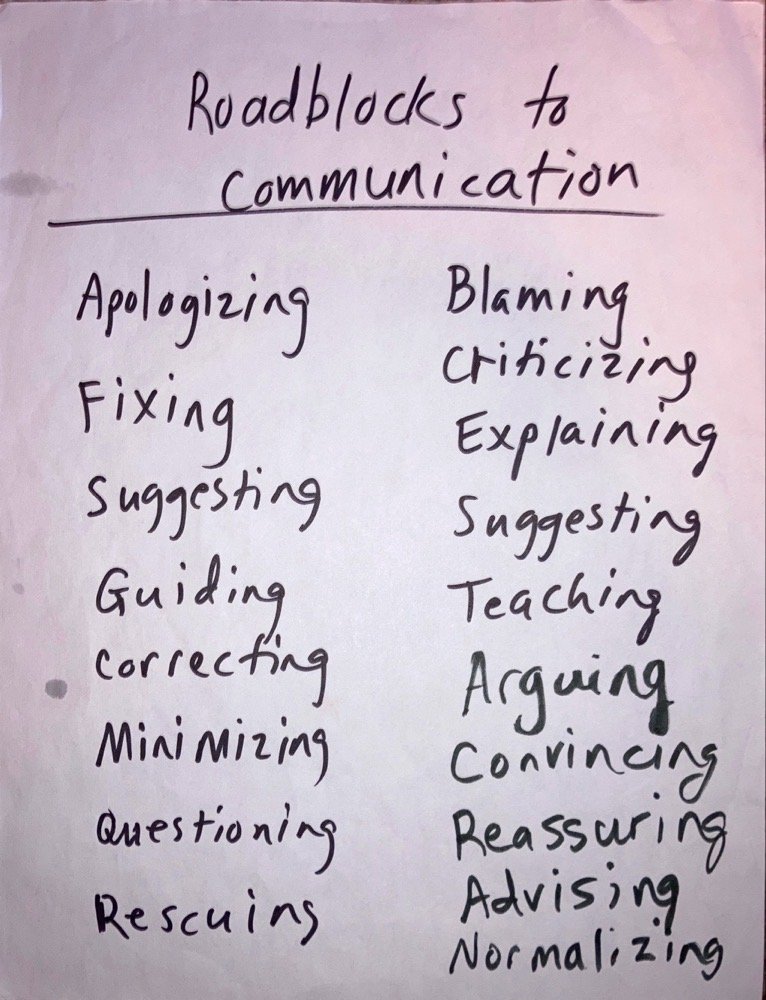
The Roadblocks to Communication: What Not to Do
Through my years of teaching parenting skills in various settings, including specialized work with divorcing families, I've identified common communication patterns that shut down emotional connection. These roadblocks include:
Apologizing ("I'm sorry you feel that way")
Fixing ("Here's what you should do")
Suggesting ("Why don't you try...")
Guiding ("You need to understand...")
Correcting ("That's not really what happened")
Minimizing ("It's not that big of a deal")
Questioning ("Why did you do that?")
Rescuing ("I'll call the school for you")
Blaming ("Well, you shouldn't have...")
Criticizing ("You're being too sensitive")
Justifying ("They probably didn't mean it")
Explaining ("Let me tell you why...")
Teaching ("This is a good lesson about...")
Arguing ("That's not how it happened")
Convincing ("You should see it this way")
Reassuring ("Everything will be fine")
Advising ("You should just ignore them")
Normalizing ("Everyone goes through this")
While these responses come from a place of love and caring, they inadvertently communicate to your child that their emotional experience needs to be changed, fixed, or understood differently. This creates disconnection rather than the connection you're seeking.
The Power of Reflective Listening: A Step-by-Step Approach
Instead of falling into these communication roadblocks, I teach parents a different approach that honors their child's emotional experience while building crucial life skills. This process requires mindfulness—the ability to notice your own emotional responses and impulses before acting on them.
Step 1: Notice Your Own Emotion
When your child shares something difficult, the first step is to recognize what's happening in your own body and emotional system. What are you feeling? Not thinking. It can take time or coaching to learn to discern between thoughts and feelings:
Anxiety about their pain?
Frustration with the situation?
Anger at whoever hurt them?
Overwhelm at not knowing how to help?
Fear about their future?
This emotional awareness—knowing your feelings by name rather than just experiencing them as thoughts or physical sensations—is the foundation of emotional intelligence. It's also essential for breaking the cycle of reactive parenting.
Step 2: Notice Your Impulse
Once you've identified your emotion, notice what impulse arises. Do you feel the urge to:
Jump in with solutions?
Minimize their concern to make yourself feel better?
Ask a bunch of questions to gather more information?
Launch into teaching mode?
Reassure them that everything will be okay?
These impulses are normal and understandable. The key is recognizing them without immediately acting on them. (Pro tip: print out the list of roadblocks to communication, so you will have that to reference until this becomes second nature).
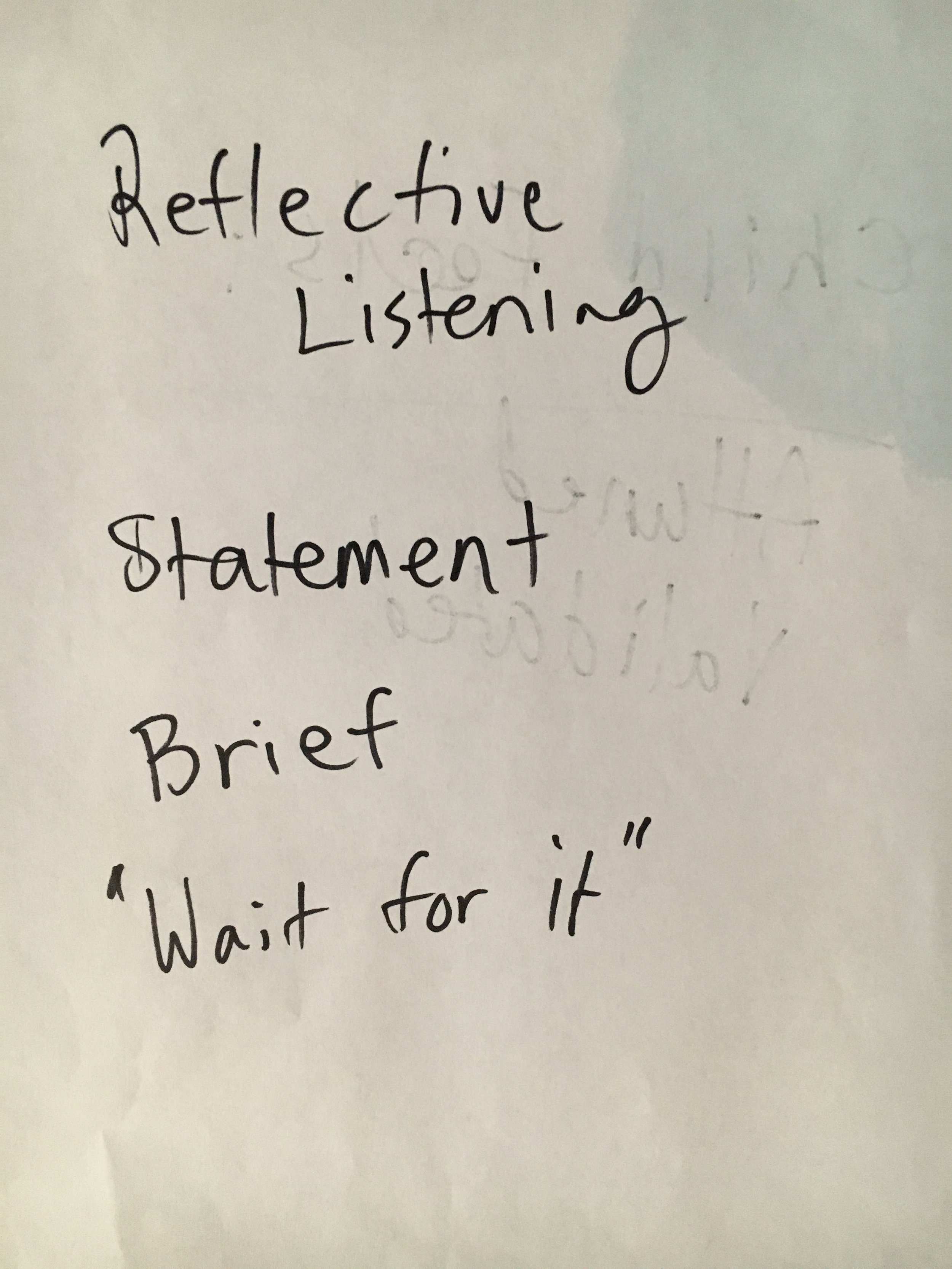
Step 3: Use Reflective Listening Instead
After noticing your emotion and impulse, deliberately choose a different response. Offer one brief reflective statement that typically begins with "You..." Examples include:
"You felt really hurt when she said that."
"You wanted him to include you."
"You needed more time to finish."
"You prefer when things are predictable."
"You wished the teacher had noticed."
Keep it to one brief sentence and avoid starting with "So you..." which can sound patronizing. Go straight to "You..." and resist the urge to add questions or additional commentary (again notice your feelings and impulses…mindfulness)
The more difficult complaints to respond to include those aimed at you. These may call for responses such as:
“You needed me to be there for you and I wasn’t"
"You hate it when I do that."
Step 4: Wait for It
After your reflective statement, stop talking (zip). This vacuum of silence invites further communication (or not….trust your child’s needs and timing. Walking away is a valid option, too) while demonstrating your faith in your child's ability to process their own experience. You're also modeling distress tolerance—showing that you can sit with the discomfort of not knowing what comes next and that you can wait for the next conversation, if that is what they need.
The "it" you're waiting for might be:
Further elaboration on their experience
Silent reflection as they process internally
A shift in their emotional state
Your child walking away, having learned they can trust you not to overwhelm them with roadblocks

Why This Approach Works: The Science Behind Connection
This reflective listening approach accomplishes several crucial things simultaneously:
Provides Attunement: You're demonstrating that you're paying attention to their internal experience, which helps them feel seen and understood. You are demonstrating “I understand” without saying it (which could be debated, debatable.)
Offers Validation: By reflecting their emotions without trying to change them, you communicate that their feelings make sense and are acceptable. While you may not agree, you are conveying (without saying it) that that is a valid thing to think or feel in their experience.
Develops Intrinsic Problem-Solving Skills: Intrinsic motivation refers to behavior driven by internal satisfaction rather than external rewards or pressures. When you resist the urge to provide solutions, you allow your child to access their own problem-solving capabilities, building confidence in their ability to handle challenges. Note here that their first attempts may demonstrate poor judgment and may even worry you. As long as they are in your company, practicing problem solving, they are not acting on any of their first impulses. You can afford to follow their immature or questionable thought process as they think it through in your company.
Models Emotional Regulation: Your calm presence in the face of their distress teaches them that emotions are manageable and temporary.
Builds Trust: Your child learns that you can handle their emotional world without trying to change or fix it, making them more likely to continue sharing with you.
The Challenge: Simple in Theory, Difficult in Practice
This approach sounds straightforward, but it requires significant skill development. Recognizing your emotions by name, noticing your impulses, and choosing reflective responses instead—all while your child is in distress—demands practice and often professional support.
Many parents find that working with a therapist helps them develop these skills more effectively. Through personalized guidance, you can learn to identify your specific emotional patterns and communication habits while practicing new responses in a supportive environment.
The Art of Following Your Child's Lead
Think of this process like being a detective—specifically, like Columbo, the famous TV detective who solved cases through patient observation and gentle questioning. You're following your child around in their mind, trying to understand their perspective without rushing to judgment or solutions.
This means accepting their pace, even when it seems immature, illogical, or frustrating. Fight the impulse to teach or correct. Your goal is understanding, not education. You can address factual inaccuracies or behavioral concerns later, after you've established emotional connection.
Don't worry about getting it "right" every time. Reflective listening is like trying to hit a moving target—your child's emotional state is constantly shifting, and your reflections won't always land perfectly. The effort itself communicates care and creates connection.

Building Momentum: The Skipping Stones Effect
Once you master single reflective responses, the challenge becomes creating a series of them—like skipping stones across water. Each reflection creates ripples that invite deeper sharing. This sustained attunement is where real healing and connection happen.
For example: Child: "Nobody likes me at school." Parent: "You feel really alone there." Child: "Yeah, and when I try to join conversations, they just ignore me." Parent: "You want to be included." Child: "It's like I'm invisible. Even the teacher doesn't notice when kids are mean to me." Parent: "You need someone to see what's happening."
Notice how each reflection opens space for deeper sharing without the parent trying to solve, question, or teach.
Integrating Additional Approaches: The Nurtured Heart and Plan B
My approach often incorporates elements from other evidence-based parenting methods, personalized to each family's needs. The Nurtured Heart Approach emphasizes recognizing and celebrating moments when children are making good choices—what we call "Kodak moments." These brief acknowledgments of positive behavior build internal motivation and self-worth.
Plan B problem-solving, developed by Dr. Ross Greene in "The Explosive Child," provides a collaborative approach to addressing persistent behavioral challenges. This method involves empathy (understanding your child's concern), defining the problem (sharing your concern), and invitation (solving the problem together).
These approaches complement reflective listening by providing frameworks for addressing behavioral issues while maintaining emotional connection.

The Embodied Approach: Integrating Mind and Body
My training in somatic experiencing, drama therapy, and other embodied modalities brings an additional dimension to this work. Emotional regulation isn't just a mental process—it's a whole-body experience. Through personalized approaches that might include movement, breathwork, or creative expression, families learn to recognize their nervous system patterns and develop practical skills for staying within their window of tolerance.
This embodied perspective recognizes that our posture, breathing, and physical presence affect our emotional state and our children's sense of safety. When you can maintain a regulated nervous system while your child processes difficult emotions, you're providing the co-regulation they need to develop their own capacity for emotional resilience.
Family Systems: Understanding the Bigger Picture
Every family operates as a system where each person's emotional state affects everyone else. Through family systems theory, I help parents understand how their responses to one child's emotions ripple throughout the entire family dynamic. When you change your communication patterns with one child, it often creates positive shifts in your relationships with all your children and even your partner. Advanced use of reflective listening might involve responding to two children at the same time, as you attune to each side of a conflict. It might also involve responding to your partner or coparent/ex-partner (for the very advanced practitioner).
This systems perspective also helps us understand how generational patterns get passed down. The communication patterns you learned in your own childhood likely influence how you respond to your children today. By developing awareness and new skills, you can break cycles that may have persisted for generations.
Internal Family Systems: Working with Your Own Parts
My specialized training in Internal Family Systems (IFS) theory adds another layer to this work. We all have different "parts" of ourselves—aspects of our personality that carry various emotions, memories, and protective strategies. When your child is upset, you might notice different parts of yourself getting activated:
The Fixer part that needs to solve everything
The Anxious part that worries about their future
The Critical part that judges their reaction
The Protective part that wants to shield them from pain
Learning to recognize and work with these parts helps you access your core Self—the part that can remain calm, curious, and connected even during your child's emotional storms.
Working with Anxiety and Avoidance
Many families I work with struggle with anxiety, which often manifests as chronic hyperarousal that narrows everyone's window of tolerance. Using Cognitive Behavioral Therapy (CBT) combined with Exposure and Response Prevention (ERP), I help families understand how avoidance actually increases anxiety over time. This approach also involves increasing distress tolerance through gradual exposure to distress.
When you can tolerate your child's distress without rushing to fix it, you're helping them build the distress tolerance that prevents anxiety from controlling their lives. This work is particularly important because anxiety often leads to avoidance behaviors that can contribute to various forms of addiction and limit life opportunities.
The Long-Term Vision: Working Yourself Out of a Job
The ultimate goal of this approach is to help your child develop intrinsic problem-solving skills and emotional resilience. Rather than learning to depend on you for solutions or getting sidetracked by engaging in conflict over refuting your advice, they develop confidence in their own ability to navigate challenges.
This doesn't mean you become passive or uninvolved. Or rejected. Instead, you become a skilled supporter who can provide emotional safety while your child develops their own capabilities. You're literally working yourself out of the job of being their emotional manager and into the role of being their secure base—someone they can return to for connection and support while maintaining their autonomy. This is a whole different kind of connection and relationship that can continue forever.

The Ripple Effects: Beyond Individual Families
When families learn these skills, the benefits extend far beyond their immediate relationships. Children who grow up with this kind of emotional attunement and support become adults who can:
Maintain healthy relationships
Navigate workplace challenges with resilience
Raise their own children with emotional intelligence
Contribute to their communities from a place of internal stability
They're less likely to struggle with addiction, anxiety disorders, or relationship conflicts because they've developed the internal strength and self-reliance to handle life's inevitable challenges.
Starting Your Journey: Personalized Support for Your Family
Every family's journey with these concepts looks different. Some families might need intensive focus on individual nervous system regulation before working on communication patterns. Others might find that improving communication naturally supports everyone's emotional development. Some parents benefit most from exploring their own childhood experiences and how they influence current parenting patterns.
My 25 years of experience with complex childhood mental health cases, combined with specialized training in family therapy, child development, drama therapy, and addiction treatment, allows me to create personalized approaches that honor each family's unique strengths and challenges.
The beauty of conducting sessions online is that families can practice these new skills in their natural environment while receiving professional guidance. This makes the transition from therapy sessions to daily life much more seamless. It might even save you some gas or a sitter. My evening availability allows you to fit sessions in between dinner and bedtime or after the kids are asleep.

Taking the First Step
If you recognize your family in these descriptions—if you're tired of conversations that end in disconnection (or worse…conflict) rather than understanding—know that change is possible. Learning to respond differently to your child's emotional expressions is one of the most powerful gifts you can give them and yourself.
This work requires patience, practice, and often professional support. The patterns we want to change have been developing for years, and transformation takes time. But even small shifts in how you respond to your child's emotions can create significant improvements in your relationship and their emotional development.
Remember, you don't have to get it perfect. You just have to be willing to try something different. Your child is waiting to see if their emotions are tolerable, if they can be vulnerable and awkward in your presence, if you can be trusted with their inner world, if you can be accountable for missteps, and if they can develop confidence in their own problem-solving abilities. Your response shapes not just this moment, but their capacity for emotional resilience throughout their lifetime.
For families ready to break these cycles and create deeper connection, I invite you to reach out for a consultation. Together, we can explore how these principles apply to your specific situation and develop personalized strategies that honor your family's unique needs while building the emotional skills that will serve you for generations to come.

Hi! I’m Julie and I’m a Licensed Therapist in California who specializes in relationships, family therapy, and child/adolescent therapy.
Call today to schedule your free consultation!
925-289-8411
